Travel Journalism’s Biggest Tension Isn’t Press Trips — It’s Access. Here’s What to Know
May 28, 2026
A recent New York Times article sparked a larger industry conversation. Inside Pitchcraft, writers shared their POVs.
Press trips are a spicy topic right now not only in travel writing circles, but in broader journalist communities. We’re seeing more outlets expand their coverage to include travel, and non-travel brands (like beauty companies and fashion houses) host trips to create an experiential connection with journalists.
Lots of questions are coming up around travel journalism ethics. At the same time, there’s a growing tension between journalists and PR professionals, who are the ones choosing whom to invite on these trips. Both sides are frustrated with pressures they’re facing. For PR pros, it’s a challenge to remain open-ended and trust that a journalist will produce without a confirmed assignment, while facing scrutiny from stakeholders to prove ROI from the investment. For writers, it’s getting harder to justify the time away and ancillary expense of press trips amidst a tough market for placing stories, not to mention low rates. There’s a great need for more transparency on both sides.
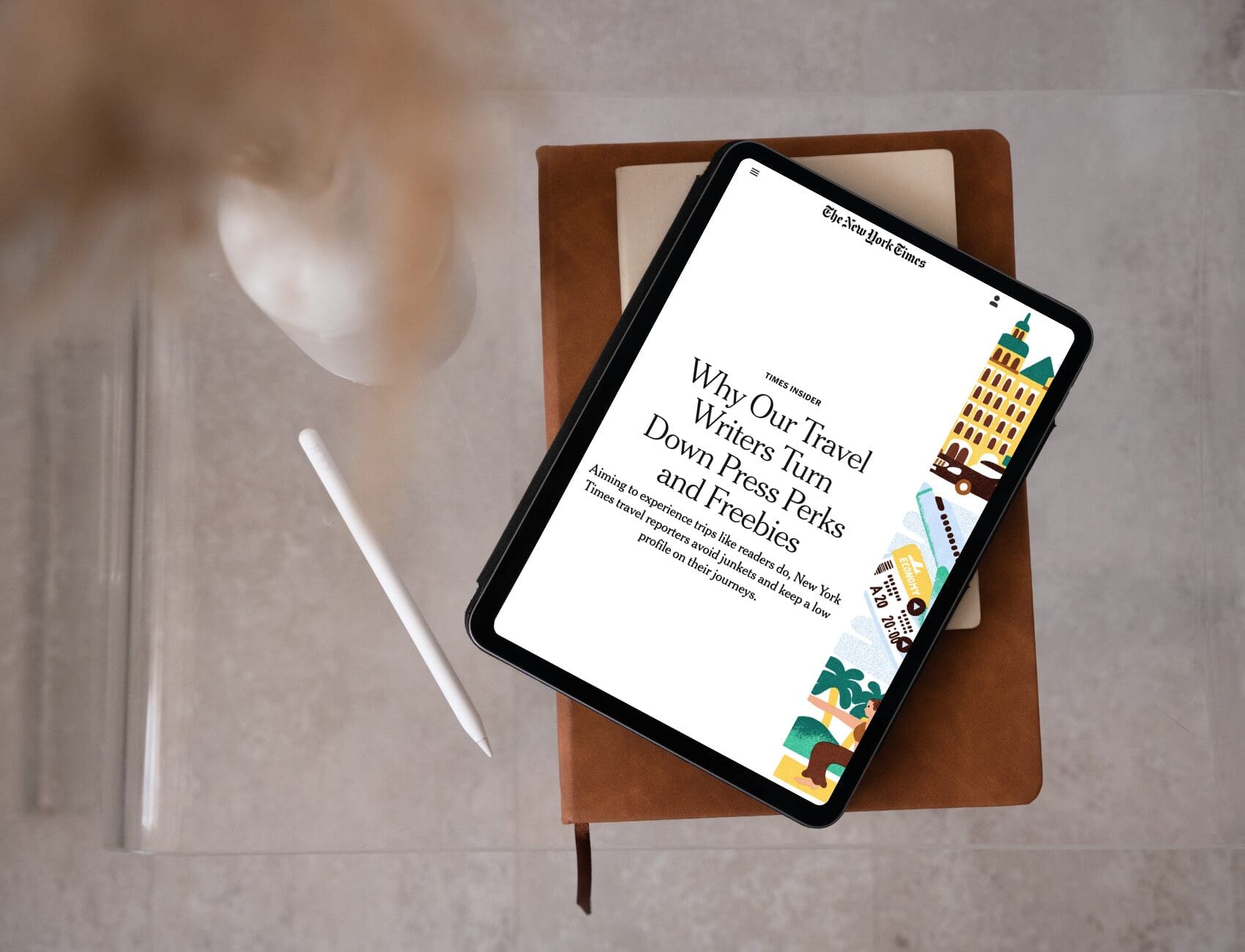
This month, an article in The New York Times added fuel to the fire. Sarah Bahr reported on why travel writers for the newspaper turn down press trips and freebies, aiming to “experience trips like readers do.”
The piece exposed a much larger conversation the industry has been having for years.
Access is increasingly a point of debate in travel media.
It’s well-known in writing circles that the Times does not accept story pitches that come from press trips. The outlet also avoids hiring freelance writers who have participated in what the writer called “freebie trips” in the past three years, even on assignment for other publications.
I’ve come across numerous writers through Pitchcraft interviews who either decline to talk about press trips at all, for fear of being “found out” by the Times, or who have never gone on a press trip their entire career due to holding out for landing their first piece in the Times.
In the piece, the Times’ Travel Editor Amy Virshup said press trips that come with itineraries and sponsor-focused priorities take away the sense of adventure that is inherent in setting out on one’s own, and the independence in covering it as a journalist.
Furthermore, the Times’ policy asks writers to book their own hotels and pay for their own meals, using their personal credit card, to be reimbursed later. The interpretation of “freebie” is taken quite seriously. Another example cited in the article explained how a Times writer insisted on paying for a meal at an all-inclusive resort she was experiencing — which made it awkward for staff, as there was no price attached.
We shared this article with our Pitchcraft community and opened up conversation. The reactions weren’t really about one publication’s policy, but instead, they reflected years of tension around access, privilege, compensation, ethics, and who gets to participate in travel journalism at all. Here’s the top five takeaways that came from our discussion.
The economics of freelance travel writing have changed.
I’ve been writing about travel for more than a decade, and rates for stories have largely stayed the same or decreased over that time period. For many outlets, payment terms have also lengthened.
For many freelancers, hosted trips have become essential to reporting beyond their home city. One writer in our community shared that she already works a second job to be able to afford to freelance as a travel writer. Another expressed that racking up a credit card bill and waiting to be paid back is not possible. “Not everyone has the luxury of being able to foot the bill and wait for reimbursement,” she said. “That immediately limits the pool of writers.”
Key takeaway: This is increasingly an economic access issue, not simply an ethics conversation.
Writers reject the idea that hosted travel automatically compromises integrity.
Many writers interpreted the piece as suggesting that hosted travel inherently weakens editorial independence, which more than one writer deemed insulting. “This piece feels incredibly out of touch with the reality of the industry right now,” one commented.
Another journalist mentioned that she recently heard an editor refer to journalists who take press trips as “tainted.”
“I employ the same objectivity when covering a hotel or destination whether it’s hosted, a reduced rate, or I paid full price out of pocket,” she said.
Many publications that cover travel and do allow press trips maintain high editorial standards and integrity.
In recent years, PR teams have also changed the way they design itineraries for press trips. Many build in ample time for free exploration or craft individual agendas even for group trips, meaning each writer can have a unique experience that caters to their specific interests and storylines.
Key takeaway: Transparency and editorial standards matter deeply. But many freelancers feel professionalism is unfairly being dismissed wholesale by outlets who prohibit press trips.
Inconsistency is frustrating.
Questions around consistency surfaced in our discussion. Several writers mentioned they’ve been on press trips with New York Times Travel contributors who don’t disclose it to editors, or who ask for media rates and are charged extremely low figures (think $25/day) just so they can say they paid.
Another editor pointed out that a double standard exists between travel contributors, who are expected to experience a destination without special treatment, and other sections of the newspaper. Food and wine critics, for example, are no longer operating from a point of anonymity for the Times. The outlet changed their policy on this about a year ago, calling it dated.
Key takeaway: When policies and real-world practices appear misaligned, it creates confusion and skepticism across the broader travel media ecosystem.
What this means for the future of travel journalism
Travel journalism is navigating a much larger industry shift. Newsroom budgets continue to shrink, while publications rely more heavily than ever on freelancers to produce deeply reported stories from around the world.
But for many freelance journalists, the deeper tension exposed by this debate is about access. Policies that effectively require writers to self-fund travel for years to remain eligible for certain outlets inevitably narrow the pool of who can participate in that work at all.
In practice, many writers argue, those standards can tip the scales toward independently wealthy contributors or those with outside financial support, while implying that freelancers who participate in hosted travel are somehow less capable of reporting objectively.
That framing struck a nerve across the industry, particularly among experienced journalists who say they maintain rigorous editorial standards regardless of how a reporting trip is funded.
What this conversation ultimately made clear is that many journalists and PR professionals are not asking for fewer standards. They’re asking for a more honest and nuanced discussion about how travel journalism actually functions today — and who is realistically able to participate in it.
These are the conversations we’re facilitating and fostering on Pitchcraft. Join us here.

Ready to join the movement?
Are you inspired to be a part of a community that demonstrates gratitude, courtesy and humility, actively striving to deepen professional relationships among journalists and PR? At Pitchcraft, we prioritize relationships over transactions and believe in taking the professional high road, always.
If you’re ready to experience the power of a relationships-focused approach and want to connect with like-minded professionals who share these values, I invite you to join us in Pitchcraft. Explore our platform and start engaging with a community that values transparency, collaboration, and mutual success. Together, we can redefine the industry standard and create a space where everyone truly enjoys firing up their laptops.
Leave a Reply Cancel reply
@joinpitchcraft
Download 25 ChatGPT prompts smart PR pros should be using in 2026
Website Design by Current Design Studio | Privacy Policy | Terms & Conditions